Research Article | | Peer-Reviewed

Impact of Open-pan Cooking Prior to Drying on Physicochemical, Phytochemical, and Antioxidant Properties of Cashew Apple Leather Puree Blends

Received: 17 June 2026     Accepted: 26 June 2026     Published: 17 July 2026
Views:       Downloads:
Abstract

In Côte d'Ivoire, 90% of cashew apples are currently wasted and converting them into fruit leather is a promising sustainable valorization strategy. This study focuses on developing cashew apple leather puree blends and evaluating the impact of cooking before drying on their characteristics. Starting with a base puree of cashew apple and mango (CMP), five formulations of leather puree were developed: F1 (CM, plain), F2 (CM-roselle), F3 (CM-tamarind), F4 (CM-baobab) and F5 (CM-ginger). Moisture content (68.95±0.66-73.91±0.08%), pH (3.19±0.01-3.26±0.03), Total soluble solids (24.34±0.03-24.74±0.02 °Brix) and titratable acidity (0.92±0.02-1.64±0.02%) varied across the formulated leather purees. Both F2 and F4 exhibited the highest total phenolic content, with F2 exhibiting the highest flavonoids and F4 the highest tannin content. The fresh purees of F2 and F1 were richer in carotenoids and vitamin C, respectively, and that of F2 exhibited the highest antioxidant activity. Significant variations in all evaluated parameters (on a dry weight basis) were observed when freshly formulated leather purees were cooked at 80 °C for 14 minutes in an open stainless-steel pan. In terms of phytochemical content and antioxidant activity, F4 and F5 showed the greatest decrease at all levels. Only F2 showed an increase in tannins. However, carotenoids, tannins, and antioxidant activity increased in F1, only the last two increased in F3. This study showed that formulating cashew apple puree blends for leather production is an effective way to produce functional snacks. However, the cooking step before drying must be customized because each blend reacts differently to heat.

Published in International Journal of Food Science and Biotechnology (Volume 11, Issue 2)
DOI 10.11648/j.ijfsb.20261102.12
Page(s) 97-112
Creative Commons

This is an Open Access article, distributed under the terms of the Creative Commons Attribution 4.0 International License (http://creativecommons.org/licenses/by/4.0/), which permits unrestricted use, distribution and reproduction in any medium or format, provided the original work is properly cited.

Copyright

Copyright © The Author(s), 2026. Published by Science Publishing Group

Keywords

Cashew Apple, Mango var. Kent, Fruit Leather Puree, Roselle Calyces, Tamarind, Baobab, Ginger

1. Introduction
In Côte d'Ivoire, cashew cultivation covers almost 1.6 million hectares with over 500,000 farming households, primarily located in the north of the country, being involved in this activity. Côte d’Ivoire is the world’s leading producer of cashew (Anacardium occidentale L.), with an annual output of over 1.2 million tons of raw nuts. However, the production of cashew apples, which typically weigh 9–10 times more than the nut itself , remains unexploited, resulting in significant waste. The transformation of cashew apples into valuable products has attracted the attention of researchers .
Another fruit from the north, mango (Mangifera indica L.), is the third-largest export product after cotton and cashew nuts . Domestic production is estimated at 135,000 tons, and around 25% of which is exported. As with cashew apples, significant post-harvest losses also occur in the mango supply chain due to the fruit's high perishability and inadequate processing and handling .
Production of fruit leather from underutilized and perishable fruits is a novel preservation technique that has proven to be an efficient means of making the most of these fruits . Fruit leather is a dried sheet of fruit pulp with a soft, rubbery texture. It is obtained by dehydrating fruit puree . Its formulation depends on the type of fruit used, as variations in acid, sugar and pectin content affect the quality of the final product . Recent studies have reported on the potential of cashew apple fruit for use in producing fruit leather. Arinzechukwu and Nkama made cashew fruit bars with a blend of ripe banana and cashew apple puree at ratios of 90:10, 80:20, 70:30, 60:40 and 50:50. Sensory scores showed that all samples were well accepted. Niveditha et al. found that leather was more acceptable when cashew puree was mixed at a ratio of 50:50 with either pineapple or orange. And, regarding mango, some recent publications on leather production include studies by Kuria et al. and Sarkar et al. .
The potential for producing innovative and functional fruit leathers by mixing cashew apple with mango and blending the resulting puree with roselle calyces, tamarind, baobab or ginger has not yet been explored. These ingredients were chosen due to their reported use in jam and fruit leather production, as well as their well-known health-promoting properties. Red roselle calyces (Hibiscus sabdariffa) are a rich source of vitamin C, minerals, organic acids, fibers and bioactive compounds. They have been successfully used in the production of various foods, including pineapple roselle leather , roselle-fig bars . Tamarind fruits (Tamarindus indica L.) are a good source of nutriment and have been used to produce tamarind date leather , tamarind jam with pepper and tamarind leather containing jaggery . The baobab fruit (Adansonia digitata L.) is an excellent source of organic acids, water-soluble pectin, calcium, iron and vitamin C. It has been used to make baobab pineapple and baobab fruit jams . Ginger (Zingiber officinale) contains several antioxidant compounds, including zingerone, gingerdiol, zingiberene, gingerols and shogaols. Its essential oil and oleoresin exhibit significant antioxidant and antimicrobial properties . Ginger has been used in leather production and as a natural preservative in carrot and mandarin blended jam .
In leather making, the processing methods generally affect the quality of final product . The leather puree or blend can be cooked or left uncooked before spreading and drying. Al-Hinai et al. , Arinzechukwu & Nkama and Sarkar et al. dried the leather puree without cooking. However, in other studies, it was heated at 70°C for 5 min , to 70-80°C until thickened , at 92°C for 2 min , or boiled . Nevertheless, literature lacks data on the impact of heat treatment on puree characteristics prior to drying into leathers. The cooking effects on pH, titratable acidity, and total soluble solids were only reported by Concha‐Meyer et al. for strawberry and kiwi fruit leather purees.
This study focuses on developing cashew apple leather purees blended with mango, roselle, tamarind, baobab and ginger. The goal of this mixing is to improve the nutritional, functional, and sensory aspects of the cashew apple fruit leather while promoting the sustainable use of by-products and underutilized resources. Additionally, the study evaluated the impact of cooking prior to drying on the physicochemical, phytochemical, and antioxidant properties of the formulated cashew apple leather puree blends.
2. Material and Methods
2.1. Preparation of Ingredients and Development of Formulations
2.1.1. Collection and Treatment of Ingredients
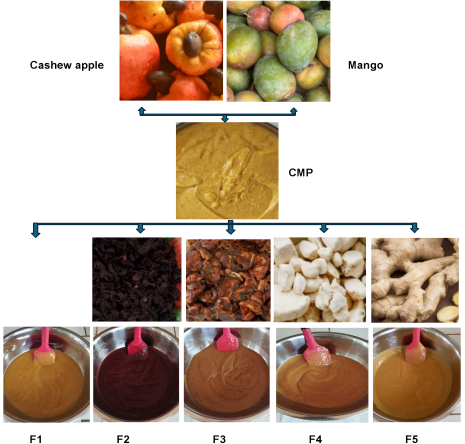
Figure 1 presents the ingredients used in the formulation of the cashew apple leather puree blends. Depending on the blending method, leather purees of various colors and flavors were developed. The cashew fruits (Anacardium occidentale L.) were collected from an orchard in Logbokaha, situated at 25 Km from korhogo (North of Cote d’Ivoire) during the peak season in 2025. After sorting, washing, disinfecting and deseeded, cashew apples were steam-blanched for 20 min, peeled and kept at – 50°C (ProfiLine Pegasus freezer, Model PLPE6286, Neo-Tech, Belgique). The mango fruits (Mangifera indica, var. Kent) and all the other ingredients used were purchased from the market. Mango fruits were washed and disinfected, and the peel and pulp were collected and stored at – 50°C. Dried roselle calyces (Hibiscus sabdariffa) were washed and blanched at 70°C for 10 minutes after addition of water (1:2 w/w) and then pureed using a food processor with Auto IQ (Ninja 3 in 1). Tamarind fruits (Tamarindus indica L.) were soaked in hot water (1:2 w/w) for six hours, after which the pulp was extracted by filtering . Baobab (Adansonia digitata) powder was mixed with hot water (1:2 w/w) to make a paste. Fresh ginger (Zingiber officinale) was washed, peeled, steam blanched for 20 minutes and then pureed after addition of 30% water . Lemons were washed, disinfected and squeezed to obtain the juice.
2.1.2. Base Puree and Cashew Apple Puree Blend Formulations
The mango puree (MP), consisting of 80% pulp and 20% peel , and cashew apple puree (CP) were blended at a ratio of 50:50 to obtain the base puree (CMP). Table 1 shows the composition of the formulated cashew apple puree blends. Formulation 1 was plain, made only with CMP. Formulations 2, 3 and 4 were prepared by mixing CMP at a ratio of 3:1 (w/w) respectively with roselle calyces, tamarind and baobab pastes. Formulation 5 was made by mixing 7% (w/w) ginger paste with CMP . The initial pH and total soluble solids (TSS) of the obtained smooth purees were checked and adjusted, using lemon juice (or sodium bicarbonate) and honey respectively.
2.1.3. Cooking the Cashew Apple Leather Puree Blends
Before cooking, each of the formulated purees were divided into 2 equal parts. One was kept as control, and the other one was poured into an open stainless-steel pan and heated to 80°C under continuous stirring within 14 minutes . The fresh and cooked purees were all kept at –50°C until needed for analysis.
Figure 1. Cashew apple fruits, mango fruits, cashew apple and mango fruit puree (CMP, base puree), F1: Cashew-mango leather puree (CM), F2: CM-roselle leather puree, F3: CM-tamarind leather puree, F4: CM-baobab leather puree, F5: CM-ginger leather puree.
2.2. Physicochemical Analysis
2.2.1. Moisture Determination
Moisture content was determined at 105°C (Memmert oven, Neo-Tech, Belgique) by drying 5 g of purees for 18 hours .
2.2.2. pH, Titratable Acidity and Total Soluble Solids Determination
Ten grams of sample were diluted in 50 mL of cold deionized water, stirred at room temperature for 30 minutes and then filtered using a nylon cloth . The pH was measured with a Hanna pH meter (HI991001, Romania). TSS was determined using a handheld standardized ATC refractometer (0-90% Brix, Model RF007BX). Titratable acidity (TA) was determined by titrating with 0.1 N NaOH until the pH reached 8.1. TA, as a percentage of citric acid, was calculated according to equation (1):
TA ww,%=E.W. of acid × Titer × N of NaOH × diluted volume × 100 1000 × aliquot taken × weight of sample (1)
E.W = Equivalent weight of the citric acid
Table 1. Formulation of cashew apple puree blends (g/100 g).

Ingredients

F1

F2

F3

F4

F5

CMP (base puree)

63.70

59.37

56.79

52.68

58.24

Roselle paste

-

19.79

-

-

-

Tamarind paste

-

-

18.93

-

-

Baobab paste

-

-

-

17.56

-

Ginger paste

-

-

-

-

4.38

Initial TSS (°Brix)

16

12

16

20

14

Initial pH

4.10

3.01

3.09

3.48

4.16

Adjustment of TSS to 25 °Brixa

Honey

21.15

20.81

24.26

18.00

21.24

Adjustment of pH to 3.2b

Lemon juice

15.15

-

-

11.76

16.14

S. bicarbonate

-

0.03

0.02

-

-

CMP: Cashew apple mango puree, TSS: Total soluble solids, S: Sodium, F1: Cashew-mango leather puree, F2: CM-roselle leather puree, F3: CM-tamarind leather puree, F4: CM-baobab leather puree and F5: CM-ginger leather puree, a: , b: .
2.3. Total Polyphenolics, Total Flavonoids, Tannins and Antioxidant Analysis
Samples were mixed with 70% methanol and kept at room temperature away from light for 12 hours . After filtration, the final volume was raised to 50 mL with the solvent and then stored at -20°C. TPC was analyzed according to , with some modifications. Briefly, extract (1 mL) was mixed with Folin-Ciocalteu’s phenol reagent (1 mL) followed by 20% (w/w) sodium carbonate solution (1 mL) and kept for 1 h at room temperature away from light. Reading was done at 765 nm, and results were expressed as mg of gallic acid equivalents (GAE) per g of sample. Flavonoids were analyzed according to Shraim et al. and expressed as mg of quercetin equivalent (QE) per g of sample. To 1 ml of the extract, 0.5 mL of 10% AlCl3 and 0.5 mL of 1 M sodium acetate were added. The mixture was kept at room temperature away from light for 30 min before reading at 415 nm. Tannins was determined with a modified method of Ayalew & Emire . Extract (0.5 mL) was mixed with 1% (w/v) vanillin solution (2.5 mL) and incubated for 30 min in the dark. Absorbance was read at 500 nm, and results were expressed as mg of tannic acid equivalent (TAE) per g of sample. Antioxidant analysis was determined using DPPH solution following the modified method of Alam et al. . Extract (100 µL) was mixed with 0.1 mM DPPH solution (3 mL) and kept in the dark at room temperature for 1 h. Absorbance of control sample, prepared by mixing the extracting solvent with DPPH solution, was taken immediately after preparation at 517 nm. The extracting solvent (70% aqueous methanol) was used as a blank. The DPPH scavenging activity was calculated based on equation (2):
Antioxidant capacity %=Ac-A0 Ac×100(2)
Ac is the absorbance of the DPPH solution (control) and A0 is the absorbance of the DPPH solution after reacting with the sample.
2.4. Carotenoids Analysis
Puree samples (10 g) were mixed with 85% acetone (30 mL) in an aluminum-foil-covered bottle and left to stand for 15 hours at room temperature . After centrifugation at 4,500 rpm for 1 minute (Sigma, Model 3-16L, Germany) supernatant was transferred to a 100 mL volume flask, topped up with 85% acetone before being analyzed at wavelengths of 662, 644, and 440 nm with a spectrophotometer (Drawell UV-VIS Model DU-8800RS, Shanghai). The crude pigment content (mg/L) was calculated as follows:
Chlorophyll a=9.784 × A662-0.990 × A644(3)
Chlorophyll b=21.426 × A644-4.650 × A662(4)
Chlorophyll a+b=5.134 × A662+20.436 × A644(5)
Carotenoids=4.695 × A440-0.268 × (a+b)(6)
А = absorbency at corresponding wavelength, the values 9.784, 0.990, 21.426, 4.650 and 0.288 are the molar absorptivity coefficient for acetone. Conversion of carotenoid content in mg/L to mg/g FW was done based on equation (7).
C (mgg)= Ccaro × V m(7)
C = carotenoid content of the sample (Fresh weight), Ccaro = concentration of carotenoids (mg/L) calculated in equation (6), V = final volume of the extract (mL), and m = weight of fresh sample used (g).
2.5. Vitamin C Analysis
Vitamin C was determined by titration with 2,6-dichlorophenol indophenol (DCPIP), according to a modified method of Nielsen . The sample (10 g) was mixed with 50 mL of 3% (w/v) metaphosphoric acid solution (HPO₃), transferred to a 100 mL volumetric flask and topped up with same solvent to the 100 mL mark. The mixture was then filtered through a muslin cloth and 5 mL of the filtrate was titrated. To standardize the dye, 5 mL of a 0.1 mg/mL standard ascorbic acid solution was mixed with 5 mL of metaphosphoric acid. The mixture was then titrated with DCPIP until a faint pink color appeared and remained visible for 15 seconds. The vitamin C content of the sample was calculated on a fresh weight basis using equation (8) and then converted to a dry weight basis using equation (9).
Vitamin C (mg100g FW)=0.5 × V2 × Vt  × 100 V × V1  × W(8)
Vitamin C (mg100g DW)=Vit C mg100gFW× 100 100 - % Moisture content(9)
0.5 = mg of ascorbic acid contained in 5 mL of the standard solution used for titration, V = volume of the dye solution required to titrate the standard solution, V1 = volume of the sample extract used for dye titration, V2 = volume of dye required to titrate the sample, W = weight of the sample used for extraction with HPO3 solution, Vt = final volume of the sample made up with HPO3 solution.
2.6. Statistical Analysis
IBM SPSS Statistics Version 22 software was used for data analysis. All data are expressed as the mean values ± standard deviation and significant differences between means were determined using the Tukey test (p < 0.05).
3. Results
3.1. Physicochemical Analysis
3.1.1. Moisture Content
The moisture content of all the formulated fresh leather purees (FP) ranged from 68.95 ± 0.66% to 73.91 ± 0.08%, and FP-F1 showed the highest moisture content (p < 0.05). A lower moisture content was observed in the leather purees when the base puree (CMP) was blended with flavoring purees made from roselle, tamarind, baobab and ginger. Of these, the FP of F3 (CM-tamarind) had the lowest moisture content (Table 2). In addition, the moisture content of the leather purees was significantly affected by the cooking process, with F3 having the lowest content. CP-F1 and CP-F2 moisture contents were not statistically significant nor were that of CP-F4 and CP-F5. Moreover, the moisture content of each formulation varied significantly (p < 0.05) between the FP and CP ones. Heating the formulated leather purees to a temperature of 80°C for 14 minutes in an open pan resulted in water losses of 6.99%, 1.47%, 6.92%, 3.21% and 5.23% for F1, F2, F3, F4 and F5, respectively.
Table 2. Moisture content of formulated fresh and cooked purees.

Formulations

Moisture (%)

FP

CP

F1

73.91 ± 0.08a,A

68.74 ± 0.56a,B

F2

70.46 ± 0.34bc,A

69.43 ± 0.14a,B

F3

68.95 ± 0.66d,A

64.16 ± 0.18c,B

F4

70.10 ± 0.38c,A

67.85 ± 0.24b,B

F5

71.17 ± 0.06b,A

67.45 ± 0.05b,B

For each parameter, numbers followed by the same letter in the same column (a, b, c) or row (A, B, C) are not significantly different based on Tukey's test 5%. FP: Fresh puree, CP: Cooked puree, F1: Cashew apple-mango (CM) leather puree, F2: CM-roselle leather puree, F3: CM-tamarind leather puree, F4: CM-baobab leather puree, F5: CM-ginger leather puree.
3.1.2. pH
Table 3. pH of the formulated fresh and cooked leather purees.

Formulations

pH

FP

CP

F1

3.19 ± 0.01b,B

3.23 ± 0.00d,A

F2

3.24 ± 0.00a,A

3.23 ± 0.01d,A

F3

3.26 ± 0.03a,B

3.33 ± 0.00a,A

F4

3.25 ± 0.01a,B

3.31 ± 0.01b,A

F5

3.20 ± 0.01b,B

3.28 ± 0.00c,A

For each parameter, numbers followed by the same letter in the same column (a, b, c) or row (A, B, C) are not significantly different based on Tukey's test 5%. FP: Fresh puree, CP: Cooked puree, F1: Cashew apple-mango (CM) leather puree, F2: CM-roselle leather puree, F3: CM-tamarind leather puree, F4: CM-baobab leather puree, F5: CM-ginger leather puree.
The initial pH of CMP was 4.10, which corresponded to the initial pH value of the F1 fresh leather puree. Blending CMP with flavorings produced initial pH values of 3.01, 3.09, 3.48 and 4.16 for F2, F3, F4 and F5 fresh leather purees, respectively (Table 1). Adjusting the pH using lemon juice or sodium bicarbonate produced values of 3.19, 3.24, 3.26, 3.25 and 3.20 for the FP of F1 to F5, respectively (Table 3). The FP of F1 and F5 had significantly lower pH values than the others. Additionally, the pH of the leather purees was significantly affected by the cooking process (p < 0.05). CP-F1 and CP-F2 exhibited the lowest pH value (3.23) while CP-F3 showed the highest (3.3). Furthermore, the CP pH value was significantly higher than the FP pH value for each formulation except for F2.
3.1.3. TSS
TSS of the base puree (CMP) was 16 °Brix, which corresponded to the initial TSS of the FP of F1. After blending CMP with each flavoring, the initial TSS values obtained for the FP of F2, F3, F4 and F5 were 12, 16, 20 and 14 °Brix, respectively (Table 1). Adding honey to each of the FP resulted in TSS values ranging from 24.34 ± 0.03 to 24.74 ± 0.02 °Brix (Table 4). These values differed statistically (p < 0.05) with FP-F4 having the highest value, followed by FP-F1. The cooking process significantly affected the TSS content of all formulated leather purees (p < 0.05). The lowest TSS value was observed for CP-F3 while the values for CP-F1 and CP-F4 were not statistically different, nor were those for CP-F2 and CP-F5. For each formulation, the TSS values of the formulated FP and their corresponding CP were not found to be statistically different (p > 0.05).
Table 4. Total Soluble Solids (TSS) and Titratable Acidity (TA) of the formulated fresh and cooked leather purees.

Formulations

TSS (° Brix)

TA (% citric acid)

FP

CP

FP

CP

F1

24.62 ± 0.02b,A

24.68 ± 0.02a,A

1.61 ± 0.02a,A

1.42 ± 0.02b,B

F2

24.39 ± 0.02cd,A

24.41 ± 0.01b,A

0.92 ± 0.02d,A

0.86 ± 0.02d,B

F3

24.34 ± 0.03d,A

24.29 ± 0.02c,A

0.98 ± 0.02c,B

1.03 ± 0.02c,A

F4

24.74 ± 0.02a,A

24.71 ± 0.02a,A

1.64 ± 0.02a,B

1.70 ± 0.02a,A

F5

24.43 ± 0.02c,A

24.42 ± 0.01b,A

1.48 ± 0.01b,A

1.40 ± 0.02b,A

For each parameter, numbers followed by the same letter in the same column (a, b, c) or row (A, B, C) are not significantly different based on Tukey's test 5%. TSS: Total soluble solids, TA: Titratable acidity, FP: Fresh puree, CP: Cooked puree, F1: Cashew apple-mango (CM) leather puree, F2: CM-roselle leather puree, F3: CM-tamarind leather puree, F4: CM-baobab leather puree, F5: CM-ginger leather puree.
3.1.4. TA
TA (% citric acid) of the formulated leather purees ranged from 0.92 ± 0.02% to 1.64 ± 0.02% and were statistically different (p < 0.05) (Table 2). Highest TA values were observed for the FP-F1 and FP-F4, while FP-F2 and FP-F3 values were low. After cooking significant difference (p < 0.05) was observed between the TA values of CP-F1 and CP-F5. For each formulation, TA value of the FP and their corresponding CP differed significantly (p < 0.05), except for F5.
3.2. Phytochemical Content and Antioxidant Activity
3.2.1. Total Polyphenolics
Table 5 shows that TPC of all formulated FP varied significantly and ranged from 1.48 ± 0.04 to 2.18 ± 0.19 mg GAE/g on a fresh weight basis. Among all the formulated fresh leather purees, TPC was higher in F2 and F4 as compared to F1, F3, and F5. A similar trend in TPC was also observed in the purees after the cooking process. Furthermore, no significant variation was observed when the TPC of the FP and CP were compared for each of the formulations.
Table 5. Total phenolics and flavonoids of the formulated fresh and cooked leather purees.

Formulations

TPC (mg GAE/g FW)

TFC (mg QE/g FW)

FP

CP

FP

CP

F1

1.52 ± 0.03b,A

1.57 ± 0.03b,A

0.99 ± 0.08c,A

0.31 ± 0.06b,B

F2

2.18 ± 0.19a,A

2.00 ± 0.03a,A

2.34 ± 0.02a,A

1.83 ± 0.19a,B

F3

1.55 ± 0.02b,A

1.48 ± 0.02b,A

1.25 ± 0.11b,A

0.26 ± 0.07b,B

F4

1.96 ± 0.19a,A

1.86 ± 0.11a,A

1.12 ± 0.11bc,A

0.31 ± 0.07b,B

F5

1.48 ± 0.04b,A

1.42 ± 0.06b,A

1.17 ± 0.06bc,A

0.36 ± 0.12b,B

For each parameter, numbers followed by the same letter in the same column (a, b, c) or row (A, B, C) are not significantly different based on Tukey's test 5%. TPC: Total phenolic content, TFC: Total flavonoids content, GAE: Gallic acid equivalents, QE: Quercetin equivalents, FP: Fresh puree, CP: Cooked puree, F1: Cashew apple mango (CM) leather puree, F2: CM-roselle leather puree, F3: CM-tamarind leather puree, F4: CM-baobab leather puree, F5: CM-ginger leather puree.
3.2.2. Total Flavonoids
TFC content of all formulated FP differed significantly. The highest TFC was found in the FP of F2 (2.34 ± 0.02 mg QE/g fresh puree) while for F3, the TFC of the FP was similar to that of the F4 and F5 purees, but different to the F1 puree. (Table 5). The TFC of each formulation was significantly reduced by heating the fresh purees.
3.2.3. Tannin Content
All the added flavorings may contain a high level of tannins, as reflected by the elevated levels found in the FP of F2-F5 (Table 6). Moreover, significant variation in tannin contents was observed between all formulated FP. The highest content was observed in F4 (354.31 ± 2.03 mg TAE/g) and the lowest in F1 (228.33 ± 3.43.mg TAE/g). With values expressed in fresh weigh basis, an increase in tannin content of formulated FP and their corresponding CP was observed after the cooking.
Table 6. Tannin and carotenoid content of formulated fresh and cooked leather purees.

Formulations

Tannins (mg TAE/g FW)

Carotenoids (µg/g FW)

FP

CP

FP

CP

F1

228.33 ± 3.43e,B

306.94 ± 0.73e,A

4.88 ± 0.12e,B

6.87 ± 0.01d,A

F2

307.42 ± 3.13c,B

384.63 ± 1.49a,A

19.22 ± 0.03a,A

16.75 ± 0.32a,B

F3

298.24 ± 2.88d,B

358.02 ± 1.27c,A

7.18 ± 0.07c,B

8.12 ± 0.06b,A

F4

354.31 ± 2.03a,B

370.81 ± 5.89b,A

6.61 ± 0.20d,A

6.65 ± 0.13d,A

F5

321.19 ± 3.12b,B

329.97 ± 2.16d,A

8.21 ± 0.22b,A

7.56 ± 0.22c,B

For each parameter, numbers followed by the same letter in the same column (a, b, c) or row (A, B, C) are not significantly different based on Tukey's test 5%. TAE: Tannic acid equivalents, FW: Fresh weigh, FP: Fresh puree, CP: Cooked puree, F1: Cashew apple-mango (CM) leather puree, F2: CM-roselle leather puree, F3: CM-tamarind leather puree, F4: CM-baobab leather puree, F5: CM-ginger leather puree.
3.2.4. Carotenoid Content
Differences in the carotenoid content were observed between all the formulated fresh purees. Values ranged from 4.88 ± 0.12 to 19.22 ± 0.03 µg/g FW and varied significantly (Table 6). The fresh puree of F2 exhibited the highest carotenoid content while F1 the least. The cooking process significantly affected the carotenoid content of all the formulated purees, and a higher content was observed in F2. Contents in CP-F1 and CP-F4 were the lowest and did not differ statistically. When comparing the content of the formulated FP and their corresponding CP on a fresh weight basis, increases were observed for the leather purees of F4, F3 and F1, while a decrease was noticed for the leather purees of F5 and F2.
3.2.5. Vitamin C
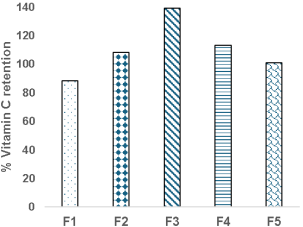
Vitamin C content varied from 110.10 ± 0.63 to 165.51 ± 0.51 mg/100 g of fresh puree (Table 7). The highest content was observed in F1 and the lowest in F3. No significant difference was observed in F4 and F5 samples. The cooking of the purees affected their vitamin C content. CP-F2 exhibited the highest content and CP-F5 the lowest. Furthermore, vitamin C content of CP was consistently higher than that of FP across all formulations. Figure 2 shows that vitamin C retention after cooking is more than 80% for each of the formulated leather puree blends.
Figure 2. Percentage retention of vitamin C. It was calculated as the ratio of vitamin C in the CP (DW) to the FP (DW) × 100. F1: Cashew-mango (CM) leather puree, F2: CM-roselle leather puree, F3: CM-tamarind leather puree, F4: CM-baobab leather puree, F5: CM-ginger leather puree.
Table 7. Vitamin C and antioxidant activity of formulated fresh and cooked leather purees.

Formulations

Vitamin C (mg/100 g FW)

Antioxidant activity (%DPPH inhibition)

FP

CP

FP

CP

F1

165.51 ± 0.51a,B

175.68 ± 0.01c,A

11.12 ± 3.85e,B

26.79 ± 5.12b,A

F2

163.05 ± 0.09b,B

182.68 ± 0.95a,A

35.67 ± 2.56a,A

29.30 ± 2.03a,B

F3

110.10 ± 0.63d,B

177.15 ± 0.07b,A

20.21 ± 5.96d,B

26.28 ± 1.55b,A

F4

142.39 ± 0.06c,B

173.57 ± 0.06d,A

27.32 ± 1.38b,A

26.11 ± 5.60b,B

F5

142.92 ± 0.13c,B

162.80 ± 0.06e,A

25.25 ± 2.60c,A

23.23 ± 5.96c,B

For each parameter, numbers followed by the same letter in the same column (a, b, c) or row (A, B, C) are not significantly different based on Tukey's test 5%. FW: Fresh weight, FP: Fresh puree, CP: Cooked puree, F1: Cashew apple-mango (CM) leather puree, F2: CM-roselle leather puree, F3: CM-tamarind leather puree, F4: CM-baobab leather puree, F5: CM-ginger leather puree.
3.2.6. Antioxidant Activity
The DPPH inhibition activity values of the formulated fresh purees ranged from 11.12 ± 3.85% to 35.67 ± 2.56%, and values were statistically different. Highest inhibition activity was observed with the FP of F2 and the lowest with the FP of F1. The cooking step significantly affected the DPPH inhibition activity of all the purees (p < 0.05) (Table 7). Moreover, when the antioxidant activity of the FP and CP of each formulation were compared, an increase was observed for F1 and F3, and a decrease for F2, F4 and F5.
Table 8. A recapitulation of the percentage variations in phytochemical parameters (based on dry weight) and antioxidant activity after cooking.

Parameters (%variation)

F1

F2

F3

F4

F5

TPC

-14.29

-11.23 (NS)

-17.43

-11.63 (NS)

-15.09

TFC

-74.22

-24.18

-88.54

-74.43

-72.91

Tannin

12.19

20.90

4.00

-2.67

-9.01

Carotenoids

17.33

-15.82

-2.04

-6.45

-18.44

AA

141.8

-21.74

30.11

-4.42

-7.98

TPC: Total phenolic content, TFC: Total flavonoids content, AA: Antioxidant activity, F1: Cashew-mango leather puree, F2: CM-roselle leather puree, F3: CM-tamarind leather puree, F4: CM-baobab leather puree and F5: CM-ginger leather puree, NS: difference between FP and CP content is not significant.
3.2.7. Recapitulation of the Impact of the Heating Process on the Phytochemical Content of Each of the Formulated Cashew Apple Leather Puree Blends
This study involved formulating cashew apple puree blends for leather production. Depending on the formulation type, heating the fresh purees significantly impacted the phytochemical content (Table 8). Cooking each formulated leather puree resulted in a reduction in TPC in F1, F3 and F5, TFC in all purees, tannins in F4 and F5, carotenoids in F2, F3, F4 and F5, and AA in F2, F4 and F5. However, no significant variation in TPC was observed after cooking for F2 and F4. An increase in Tannins was noticed for F1, F2 and F3 purees, an increase in carotenoids was noticed for F1, and an increase in AA was also noticed for F1 and F3 purees. Overall, F1 was least affected by the heating process, as reflected by its higher antioxidant activity. The fresh leather purees F4 (CM-baobab) and F5 (CM-ginger) were the most affected by the heating process. Therefore, it can be stated that cooking the cashew apple blend before drying, a common step taken to ensure safety and improve texture, significantly altered the chemical composition of the resulting purees.
4. Discussion
4.1. Moisture Content
During the formulation process, the base puree (CMP) was prepared by blending cashew apple and mango purees at a ratio of 50:50, as this combination received the higher overall acceptability for cashew apple-mango jam and cashew apple-pineapple leather . Here, all the formulated FP contained CMP in various proportions, with the highest level found in FP-F1 (with no added flavorings). Mango pulp and cashew apples are naturally high in water , which, when combined with lemon juice and honey, contributed to the high moisture level of the FP-F1. The low water loss percentage in the F2 and F4 leather purees is probably because the flavorings used in their formulations (roselle and baobab pastes, respectively) had a much denser consistency than those used in the other samples and probably because less free water was available for evaporation due to high pectin content of these pastes .
4.2. pH of the Purees
In this study, the cashew apple puree had a pH of 4.3 ± 0.01 and was within the range reported by Adou et al. (4.37-4.5). The pH value of the mango puree was 3.98 ± 0.02 and was within the range reported by Anon et al. (3.38-4.42). The reduced pH values observed for the F2 (CM-roselle), F3 (CM-tamarind), and F4 (CM-baobab) flavored FP was probably due to the more acidic nature of the flavorings used in these formulations . Aslam et al. also reported a reduction in the pH of roselle formulations during the production of fruit leather and bars. For F5, the pH of the flavored FP increased slightly to 4.16, probably because ginger is less acidic than the other flavorings . To ensure proper gel formation during the drying process of the purees, firstly, the pectin content of the mango puree was improved by adding mango peel at a ratio of 80:20 . Secondly, the initial pH of all formulations was adjusted to 3.2 to create favorable conditions for pectin gelation and thereby improving the texture of the dried product . The variability observed in the adjusted pH values (Table 2) was most likely caused by experimental errors. This is because the pH of the formulations was manually adjusted and checked every 30 minutes after the addition of lemon juice or sodium bicarbonate, following the method described by Tangpao et al. . The cooking process increased the pH value of the F1, F3, F4 and F5 leather purees, and this is probably due to the breakdown of heat-sensitive and soluble acids, the reduction of active carboxylic groups in proteins, and the release of calcium and magnesium ions from proteins .
4.3. TSS Content
Blending CMP with roselle and ginger pastes resulted in a decrease in the TSS value of the FP of F2 and F5. This is probably due to the dilution effect, given that roselle and ginger have a low sugar content . Conversely, when CMP was blended with baobab paste, the TSS content of the formulated leather puree (F4) increased, probably due to the high sugar content of the baobab powder . Anand et al. stated that, in order to make the final leather products more appealing to customers who prefer sweeter foods, the purees used in their production must have a high sugar content. Consequently, the TSS content of all the formulated FP was adjusted to 25 °Brix , unfortunately, the adjusted TSS value for all the formulated leather purees was below 25 °Brix and remained unaffected by the cooking process. This may be because, although honey adds soluble solids and sweetness, it contributes slightly less TSS due to its water content .
4.4. TA (% Citric Acid)
Titratable acidity, which consists of various organic acids, plays a central role in the sensory quality of fruit puree and is a major contributor to its acidity . In this study, lemon juice was used to reduce the pH of the FP of F1, F4, and F5 to 3.2. And since lemon juice is naturally rich in citric acid , its addition to the leather purees might have increased the acid content of these formulations. Regarding the FP of F2 and F3, the pH was increased by using a basic weak acid salt, such as sodium bicarbonate, to neutralize some of the naturally occurring organic acids present in the leather purees . The reduced TA values observed after heating F1 and F2 may be attributed to acid breakdown , whereas the increase observed in CP-F3 and CP-F4 may be the result of thermal degradation of complex compounds such as polysaccharides and phenolic compounds into small-molecule organic acids, or due to water loss and solute concentration .
4.5. Total Polyphenolic Content
Polyphenols are compounds that act as antioxidants, antimutagens, antimicrobials and anticarcinogens. They inhibit the proliferation of cancer cells, decrease lipid oxidation and lower cholesterol. The higher content of TP found in the FP of F2 (CM-roselle) and F4 (CM-baobab) may be attributed to its high level in each of the flavorings used in these formulations . With results expressed on a fresh weight basis (Table 5, fresh weight), an apparent stability of the TPC in the leather purees after heating was observed. Saarniit et al. linked stable content of TP after cooking to the presence of temperature-stable compounds. In addition, TPC stability depends on the formulated product's specificity, which generally depends on the type and quantity of ingredients used and the pH level. More specifically, the stability may be attributed to bound phenolic acids being released to compensate for the degradation of heat-sensitive compounds, or to the acidic pH level preserving the phenolic compounds . However, when these values are expressed on a dry weight basis (data not shown), a substantial decrease in the TP content of each of the formulated leather purees was observed. Yet, the extent of the decrease varied according to the type of puree formulated. The greatest reduction in TP value was observed in CP-F3 (17.43%), followed by CP-F5 (15.09%), CP-F1 (14.29%), CP-F4 (11.66%) and CP-F2 (11.23%). The low percentage of TPC reduction in F2 and F4 leather purees after cooking may suggest that the phenolic compounds in these purees are more stable than those present in the other formulations. Thus, it could be inferred that all the formulated leather purees contain a mixture of stable and less stable bioactive compounds in various quantities.
4.6. Total Flavonoid Content
Flavonoids are a class of organic compounds characterized by a variety of phenolic structures. They exhibit promising anti-diabetic, anti-inflammatory, antibacterial, antioxidant, antiviral, cytotoxic and lipid-lowering activities . Their high content in roselle calyces might explain the elevated amount found in the fresh puree of F2. The reduction in TFC upon cooking (Table 5, fresh weight basis) may suggest that each of the formulated leather puree contains high amount of flavonoid compounds that are less stable . When values are reported on a dry weight basis (data not shown), the smallest decrease in TF value was observed in CP-F2 (24.18%) while the greatest decrease was seen in CP-F3 (88.54%), followed by CP-F1 (74.22%), CP-F4 (74.43%) and CP-F5 (72.91%). The results highlight the much greater stability of the flavonoid compounds present in F2 leather puree compared to the others.
4.7. Tannin Content
Tannins are a diverse class of polyphenolic compounds known for their antioxidant, anti-inflammatory and cardioprotective properties. They have been linked to a lower incidence of chronic conditions such as cardiovascular disease, cancer, and diabetes. In addition, tannins significantly contribute to sensory and nutritional characteristics by influencing flavor, color and nutrient absorption . In this study, the astringency of the cashew apple, primarily caused by soluble tannins , was reduced by steaming-blanching the fruits for 20 minutes prior to preparing the base puree (CMP). The high amount of tannin found in the FP of F4 may illustrate its high level in baobab powder. The apparent increase in tannin content (Table 6, fresh weight basis) could be due to the softening or disruption of the plants' cell walls and the breakdown of complex phenolic compounds into simpler ones . However, when the values are reported on a dry weight basis (data not shown), an increase in tannin levels was only observed in F1 (12.19%), F2 (20.90%) and F3 (4.00%) purees. This increase is consistent with the recurrence of tannins in tannin-rich fruit purees upon heating, as reported by Tsurunaga et al. . On the contrary, the reported values on a dry weight basis (data not shown) showed a decrease in tannin content for F4 (2.67%) and F5 (9.01%) leather purees. From this decrease, it can be inferred that adding baobab and ginger to CMP reduced the solubilization of tannins upon heating. Baobab is a rich source of pectin , so incorporating it into CMP may have increased the total pectin content of the resulting puree. Since pectin forms complexes with insoluble tannins when water evaporates during heating , the increase in pectin levels due to concentration may have favored higher rates of immediate complexation with the insoluble tannins in this puree. The presence of baobab in the formulated puree may also have resulted in less cell walls rupturing, leading to greater retention of bound tannins. Overall, it is hypothesized that the formation of complexes between pectin and insoluble tannins, and between proteins and soluble tannins, has reduced the level of measurable tannins in both purees .
4.8. Carotenoid Content
Carotenoids are fat-soluble compounds that are responsible for the color of many fruits and vegetables. Due to their antioxidant properties, they may reduce the risk of diabetes and inhibit the development of cardiovascular disease . The variation observed in the carotenoid content of all the formulated FP may be due to the natural levels of carotenoids in the ingredients used in the formulation, as well as the quantities used . After cooking, an apparent increase in content (Table 6, fresh weight basis) was observed. An increase in carotenoids content after heat cooking, is thought to be due to the release of more compounds from the cell matrix , or to the presence of a greater quantity of more stable compounds . But when these carotenoids values are reported on a dry weigh basis (data not shown), a decrease in the content was noticed in all the cooked purees except in CP-F1 where an increase in the content (17.23%) was observed. A higher content of carotenoids for orange-fleshed sweet potatoes boiled for between 15 and 35 minutes was reported by Kourouma et al. . For the other purees, the extent of the decrease varied depending on the formulation type. CP-F5 showed the highest decrease (18.44%), followed by CP-F2 (15.82%), CP-F4 (6.45%) and finally CP-F3 (2.04%).
4.9. Vitamin C Content
Vitamin C is essential for maintaining connective tissue throughout the body, including in the skin, blood vessels and bones. Regarded as a physiological antioxidant, vitamin C is an essential nutrient for maintaining good health . As vitamin C is both water-soluble and sensitive to heat, it can easily degrade during cooking. Severe losses of vitamin C have been found to result from high temperatures and long cooking times. In this study, all the formulated FP contains different levels of vitamin C (Table 7, fresh weight basis), and this may mostly be due to the type and quantity of ingredients used during the formulation . When the vitamin C content values are reported on a dry weight basis (Figure 2), a retention greater than 80% was observed when each formulated puree was heated to 80°C within 14 minutes. The percentage retention of vitamin C was calculated as the ratio of vitamin C in the cooked sample to that in the fresh sample × 100 . F1 puree had the lowest retention, while F3 puree had the highest vitamin C retention after cooking. This outcome is probably due to the combination of moderate temperature and acidic pH, which may have had a protective effect . Similar observation was also reported by Lee et al. when broccoli was either steamed for 10 min or microwaved for 2 min.
4.10. Antioxidant Activity
Antioxidants are chemicals that neutralize free radicals by providing them with electrons, thereby minimizing the damage they cause to the body . Since a higher percentage of DPPH radical scavenging activity indicates stronger antioxidant capacity , it can be concluded that the FP-F2 exhibits the strongest scavenging activity, followed in order of decreasing strength by FP of F3, F5, F4, and F1. Since antioxidant activity in foods is related to the presence of phytochemicals , vitamin C and carotenoids , as well as to the pH and type and quantity of ingredients used in formulations , the observed outcomes may be explained by these factors. Cooking the formulated FP increased the antioxidant activity (AA) of F1 and F3, but decreased that of F2, F4 and F5 (Table 7). Greater increase in AA was noticed with CP-F1 (141.08%) than with CP-F3 (30.11%). The highest increase in AA observed in CP-F1 may be related to the increased levels (dry weight basis) of both tannins (12.19%) and carotenoids (17.50%) in the leather puree. Tannins and carotenoids are reported as potent antioxidants that can effectively scavenge free radicals. The reduced AA observed in the other formulations may be due to the antioxidant compounds being inactivated during cooking. The greatest reduction in value was observed in CP-F2 (21.76%), followed by CP-F5 (7.98%) and CP-F4 (4.42%). The CP of F2 and F5 exhibited significantly greater reductions in DPPH inhibition capacity, likely due to their substantial decrease in carotenoid content (15.82% and 18.44%, respectively).
5. Conclusions
Developing fruit leather formulations with cashew apple and mango purees may reduce waste in the supply chains of both fruits while providing consumers with healthy processed products. This study successfully formulated plain cashew apple mango leather puree (F1) as well as mixed formulations with various flavors, such as roselle (F2), tamarind (F3), baobab (F4) and ginger (F5). These blends resulted in formulations with different physiochemical, phytochemical, and antioxidant properties. Significant changes in these properties were observed when each formulated puree was cooked prior to being dried into leather (final product). The extent of the impact depends largely on the ingredients used in the formulation. This study showed that to preserve the functional properties of each formulated cashew apple leather puree blends, the cooking step must be customized, as each blend reacts differently to heat.
Abbreviations

CMP

Cashew Mango Puree

TSS

Total Soluble Solids

FP

Fresh Puree

CP

Cooked Puree

F1

Cashew Mango Leather Puree

F2

Cashew Mango Roselle Leather Puree

F3

Cashew Mango Tamarind Leather Puree

F4

Cashew Mango Baobab Leather Puree

F5

Cashew Mango Ginger Leather Puree

EW

Equivalent Weight

TPC

Total Phenolic Content

TFC

Total Flavonoid Content

TAE

Tannic Acid Equivalent

GAE

Gallic Acid Equivalent

QE

Quercetin Equivalent

FW

Fresh weight

DW

Dry weight

A

Absorbance at Corresponding Wavelengths of Pigment

C

Pigment Content of the Sample

Ccarro

Concentration of Carotenoid in mg/L

L

Liter

V

Volume of the Dye Solution Required to Titrate Standard

V1

Volume of the Sample Extract

V2

Volume of the Dye Required to Titrate Sample

W

Weight of the Sample

HPO

Metaphosphoric Acid

Vt

Final Volume of the Sample

Ac

Absorbance of DPPH Solution (Control)

A0

Absorption of DPPH Solution after Reacting with Sample

DPPH

2,2-diphenyl-1-picrylhydrazyl

Author Contributions
Sylvie Assoi: Conceptualization, Data curation, Formal Analysis, Investigation, Methodology, Resources, Writing – review & editing, Writing – original draft
Michel Archange Libra: Conceptualization, Data curation, Formal Analysis, Writing – review & editing
Say Jean-Baptiste Anouhe: Conceptualization, Data curation, Formal Analysis, Investigation
Bio Sigui Bruno Bamba: Conceptualization, Data curation, Methodology, Resources, Supervision, Writing – review & editing
Doudjo Soro: Conceptualization, Methodology, Supervision, Validation, Writing – review & editing
Data Availability Statement
The data is available from the corresponding author upon reasonable request.
Conflicts of Interest
The authors declare no conflicts of interest.
References
[1] Osei, E. D., Amotoe‐Bondzie, A., Ataa Pokuah, A., Laar, W. S., Afoakwah, N. A., Ivanišová, E. Cashew Apple Pomace: Chemical Composition and Applications in Functional Food Product Development-a Review, Food Science and Nutrition. 2025, 13, e70185.
[2] Zie, M., Alabi, T., Karamoko, G., Blecker, C. Valorization of Cashew Apple Bagasse in Food Application: Focus on the Use and Extraction of Nutritional or Bioactive Compounds, Food and Humanity. 2023, 1, 848–863.
[3] ECOWAS Mango Value Chain Available from:
[4] Ballo, A., Kouame, K., Coulibaly, L. F., Camara, B. Assessment of Mango Losses by Value Chain Partners in the Korhogo Department, Northern Côte d’Ivoire, Journal of Experimental Agriculture International. 2025, 47(10), 1–16.
[5] Alam, M. H., Ahmad, M. H., Imran, M., Rehman, M. U., Khan, M. I., Khan, M. K., Khalid, W., Alharbi, S. A., Aljawdah, H. M., Madilo, F. K. Production of Stevia‐based Persimmon Fruit Leather by Microwave Oven and Its Optimization with Response Surface Methodology, Food Science & Nutrition. 2025, 13(2), e70036.
[6] Addai, Z. R., Abdullah, A., Mutalib, S. Abd., Musa, K. H. Evaluation of Fruit Leather Made from Two Cultivars of Papaya, Italian Journal of Food Science. 2016, 28(1), 73–82.
[7] Giacalone, G., Da Silva, T. M., Peano, C., Giuggioli, N. R. Development of Fruit Leather from Actinidia Arguta By-Product: Quality Assessment and Shelf-Life Studies, Italian Journal of Food Science. 2019, 31(3).
[8] Arinzechukwu, C. S., Nkama, I. Production and Quality Evaluation of Fruit Bars from Banana (Musa Sapientum) and Cashew (Anacardium Occidentale) Apple Fruit Blends, Asian Food Science Journal. 2019, 10(2) 1–16.
[9] Niveditha, C., Veena, B. M., Shweatha, H. E. Formulation of Cashew Apple-Based Products for Nutrition-Centric Sustainability, International Journal of Science and Research Archive. 2024, 12(1), 2169–2178.
[10] Kuria, M. W., Matofari, J. W., Nduko, J. M. Physicochemical, Antioxidant, and Sensory Properties of Functional Mango (Mangifera Indica L.) Leather Fermented by Lactic Acid Bacteria, Journal of Agriculture and Food Research. 2021, 6, 100206.
[11] Sarkar, T., Salauddin, M., Hazra, S. K., Chakraborty, R. Effect of Cutting-Edge Drying Technology on the Physicochemical and Bioactive Components of Mango (Langra Variety) Leather, Journal of Agriculture and Food Research. 2020, 2, 100074.
[12] Alam, M. S., Kamruzzaman, M., Khanom, S. A. A., Patowary, M. R. H., Elahi, M. T., Hasanuzzaman, Dipak, K. P. Quality Evaluation of Ginger Candy Prepared by Osmotic Dehydration Techniques, Food and Nutrition Sciences. 2018, 9, 376–389.
[13] Aslam, H., Nadeem, M., Shahid, U., Ranjha, M. M. A. N., Khalid, W., Qureshi, T. M., Nadeem, M. A., Asif, A., Fatima, M., Rahim, M. A., et al. Physicochemical Characteristics, Antioxidant Potential, and Shelf Stability of Developed Roselle–Fig Fruit Bar, Food Science & Nutrition. 2023, 11(7), 4219–4232.
[14] Al-Hinai, K. Z., Guizani, N., Singh, V., Rahman, M. S., Al-Subhi, L. Instrumental Texture Profile Analysis of Date-Tamarind Fruit Leather with Different Types of Hydrocolloids, Food Science and Technology Research. 2013, 19(4), 531–538.
[15] Neto, A. S., De Oliveira, A. P. B., Da Silva, A. C. P., Pacheco, C. S. G. R. Innovative Business Model: The Production of Tamarind Jam with Pepper in the Northeastern Semiarid, International Journal of Advanced Engineering Research and Science. 2021, 8(1), 166–171.
[16] Kurwave, H. S., Gadhe, K. S., Kamble, R. E. Standardization and Development of Tamarind Leather with Incorporation of Liquid Jaggery, The Pharma Innovation Journal. 2023, 12(12), 464–468.
[17] Millicent, O.-A., Bigson, K., Akwaah, V. Preparation and Quality Evaluation of Baobab Fruits Pulp and Pineapple Blended Jam, EPRA International Journal of Agriculture and Rural Economic Research. 2021, 9(3), 5–12.
[18] Wasihun, A. A., Berhe, G. G., Sbhatu, D. B., Abay, K. H., Gebreyohannes, G. Quality Jam from Baobab (Adansonia Digitata L) Fruit Pulp Powder: Formulation and Evaluation of Its Physicochemical and Nutritional Properties, Journal of Food Quality. 2023, 2023, 1–12.
[19] Wakchaure, R., Ganguly, S. Phytochemistry and Pharmacological Properties of Ginger (Zingiber Officinale). In Molecular Biology and Pharmacognosy and Beneficial Plants, Lenin Media Private Limited: Delhi, India, 2018, Vol. I, pp. 97–103.
[20] Kaushal, M., Dhiman, A., Vaidya, D. Formulation, Acceptability and Storage Stability of Appetized Ginger Plum Leather, International Journal of Environment, Agriculture and Biotechnology. 2017, 2(1), 389–396.
[21] Ullah, I., Muammad, A., Ullah, N., Ali, U., Khan, S., Khan, I. Effect of Natural Preservative (Ginger Extract) on the overall Quality of Carrot and Kinnow Blended Jam, International Journal of Horticulture and Food Science. 2020, 2(1), 01–09.
[22] Diamante, L. M., Bai, X., Busch, J. Fruit Leathers: Method of Preparation and Effect of Different Conditions on Qualities, International Journal of Food Science. 2014, 2014, 1–12.
[23] Hamzah, F. H., Herawati, N., Yunita, I., Sriwulandari, A. Sensory Analysis of Fruit Leather from the Combination of Pedada Fruit and Api-Api Fruit as Natural Dyes, IOP Conference Series: Earth and Environmental Science. 2023, 1182(1), 012056.
[24] Ahmad, N., Shafi’i, S. N., Hassan, N. H., Rajab, A., Othman, A. Physicochemical and Sensorial Properties of Optimized Roselle-Pineapple Leather, Malaysian Journal of Analytical Sciences. 2018, 22(1).
[25] Concha‐Meyer, A. A., D’Ignoti, V., Saez, B., Diaz, R. I., Torres, C. A. Effect of Storage on the Physico‐Chemical and Antioxidant Properties of Strawberry and Kiwi Leathers, Journal of Food Science. 2016, 81(3), C569–C577.
[26] Nurerk, P., Junden, S. Product Development Based Sensory Evaluation and Physicochemical Characterization of Cashew Apple Bagasse Jam and Technology Transfer to Community, Trends in Sciences. 2021, 18(22), 454–454.
[27] Firdaus, D. O., Wulandari, A., Panjaitan, T. W. S. Spreadability, Total Dissolved Solids and Likeability of Mango Jam with a Combination of Mango Flesh and Peel Arum Manis (Mangifera Indicates L), Agricultural Science. 2023, 79(1), 10–18.
[28] Chim, C., Channa, L., Phanna, L., Puthearith, T., I, D. E. Physicochemical Properties and Sensory Analysis of Cashew Apple (Anacardium occidentale L.) - Mango (Mangifera indica) Blends Jam, Advances in Nutrition and Food science. 2021, 2021(03).
[29] Ajala, A. S., Ajalo, I. A. Production and Quality Evaluation of Ginger-Flavoured Banana Marmalade, International Journal of Emerging trends in Engineering and Development. 2012, 7(2), 579–584.
[30] Tangpao, T., Phuangsaujai, N., Kittiwachana, S., George, D. R., Krutmuang, P., Chuttong, B., Sommano, S. R. Evaluation of Markers Associated with Physiological and Biochemical Traits during Storage of ‘Nam Dok Mai Si Thong’ Mango Fruits, Agriculture. 2022, 12(9), 1407.
[31] Yadav, K., Anish, D., Santosh, T., Samiksha, R., Krishna, C., Shiwakoti, L. D., Shiwakoti, R., Katuwal, N. Nutritional, Phytochemicals, and Sensory Analysis of Lapsi (Choerospondias Axillaris Fruit Leather, International Journal of Food Properties. 2022, 25(1), 960–975.
[32] Shraim, A. M., Ahmed, T. A., Rahman, M. M., Hijji, Y. M. Determination of Total Flavonoid Content by Aluminum Chloride Assay: A Critical Evaluation, LWT. 2021, 150, 111932.
[33] Ayalew, G. M., Emire, S. A. Formulation and Characterization of Fruit Leather Based on Annona Muricata L. Fruit and Avena Sativa Flour, Journal of Food Processing and Preservation. 2019, 44(1), 1–18.
[34] Mohamed, A., Ragab, M., Siliha, H., Haridy, L. Physicochemical, Microbiological and Sensory Characteristics of Persimmon Fruit Leather, Zagazig Journal of Agricultural Research. 2018, 45(6), 2071–2085.
[35] Nielsen, S. S. Vitamin C Determination by Indophenol Method. In Nielsen’s Food Analysis Laboratory Manual, Ismail, B. P., Nielsen, S. S., Eds., Food Science Text Series, Springer International Publishing: Cham, 2024, pp. 153–156.
[36] Bosson, A. J.-C., Toure, A., Zoro, A. F., Kablan, A. L. C., Coulibaly, A., Zoue, L. Y. T. Evaluation of Physicochemical, Nutritional and Antioxidant Parameters of Pulp During Post-Harvest Ripening of Kent Variety Mango from Northern Côte d’Ivoire, Journal of Food and Nutrition Research. 2022, 10, 386–391.
[37] Foltz, M., Zahradnik, A. C., Van Den Abbeele, P., Ghyselinck, J., Marzorati, M. A Pectin-Rich, Baobab Fruit Pulp Powder Exerts Prebiotic Potential on the Human Gut Microbiome in Vitro, Microorganisms. 2021, 9(9), 1981.
[38] Nasution, Z., Chang, Y. L., Amir, I. Z., Fisal, A., Mohd, N. L. Effect of Pectin Concentration and Drying Condition on Physicochemical Properties and Sensory Acceptance of Roselle (Hibiscus Sabdariffa L.) Leather. In International conference on sustainable agriculture and food security: Challenges and opportunities 2011. Bandung, Indonesia, 2011, pp. 1-11.
[39] Adou, M., Tetchi, F. A., Gbane, M., Kouassi, K. N., Amani, N. G. Physico-Chemical Characterization of Cashew Apple Juice (Anacardium Occidentale, L.) from Yamoussoukro (Côte d’Ivoire), Innovative Romanian Food Biotechnology. 2012, 11, 32–43.
[40] Anon, A. H., Guede, S. S., Nyamien, Y. B. J., Fagbohoun, J. B., Kouame, L. P. Effect of Mango Shelf Life on Sensory Properties of Puree Produced in Côte d’Ivoire, World Journal of Advanced Research and Reviews. 2025, 25(3), 789–798.
[41] Yeboue, K. H., Silue, F. E., Amonkan, K. A., Atouloukou, E. S., Konan, B. A. Effect of a Baobab Powder Diet on Growth and Digestive Balance in Growing Rats, Scholars Academic Journal of Biosciences. 2023, 11(09), 308–314.
[42] Choi, E.-J., Lee, K.-A., Kim, B.-S., Ku, K.-H. Effect of Pre-Treatment and Storage Conditions on the Quality Characteristics of Ginger Paste, Preventive Nutrition and Food Science. 2012, 17(1), 46–52.
[43] Razzak, A., Mahjabin, T., Khan, R. M., Hossain, M., Sadia, U., Zzaman, W. Effect of Various Cooking Methods on the Nutritional Quality and Safety of Selected Vegetables from Bangladesh’s North-Eastern Area. Preprint. 2023.
[44] Anand, J., Dena, R. G., Jebin, S., Libin, J., Amith, A., Lakshmi, M. Development and Evaluation of Physicochemical, Sensory, and Microbiological Properties of Fruit Leather from Underutilized Tropical Fruits, Future Postharvest and Food. 2025, 2(4), 432–443.
[45] Riram, K., Maibam, P. S., Kumari, K., Srikanth, P. Development of Nutrition Rich Mixed Fruit Leather from Apple and Papaya: A Review, BIO Web of Conferences. 2024, 110, 1–15.
[46] Das, U., Hasan, M. A. B., Hussain, T., Rahman, A., Mahmood, A., Marma, S., Tasnia, J., Akter, S., Barua, S., Fabia, N. S. Physicochemical, Nutritional, and Sensory Attributes of High Fiber Fruit Leather of Red Dragon Fruit-Peel and Mango. Journal of Food Quality and Hazards Control. 2025, 12(1), 27–36.
[47] Zhu, H., Tian, J., Ning, J., Dao, R., Pan, F., Chen, M., Liu, Z., Lu, M., Liu, M., Ao, C., et al. Effect of Steaming on the Quality Characteristics of Jujube Fruit: A Study of Physicochemical Properties, Antioxidant Activity and Processing Suitability across Multiple Cultivars, Food Chemistry: X. 2025, 31, 103108.
[48] Cernătescu, C., Potop, C., Cernătescu, M. M., Cobzaru, C. Quantitative Analysis of Lemon Juice, Buletinul Institutului Politehnic Din Iaşi. 2023, 69(73).
[49] Wang, F., Wang, Y., Shen, X., Zhao, R., Li, Z., Wu, J., Shen, H., Yao, X. Research Progress on Methods for the Deacidification of Small Berry Juice: An Overview, Molecules. 2024, 29(19), 4779.
[50] Monteiro, S., Reboredo, F. H., Lageiro, M. M., Lourenço, V. M., Dias, J., Lidon, F., Abreu, M., Martins, A. P. L., Alvarenga, N. Nutritional Properties of Baobab Pulp from Different Angolan Origins, Plants. 2022, 11(17), 2272.
[51] Yusoff, N. A., Ahmad, F. T., Mubarak, A., Mohd Razali, R., Mohd Rafdi, H. H. Antioxidant Compounds and Activities of Roselle (Hibiscus Sabdariffa L.) Decoction Residues from Cordial and Juice Production, Malaysian Applied Biology. 2024, 53(3), 239–253.
[52] Saarniit, K., Lang, H., Kuldjärv, R., Laaksonen, O., Rosenvald, S. The Stability of Phenolic Compounds in Fruit, Berry, and Vegetable Purees Based on Accelerated Shelf-Life Testing Methodology, Foods 2023, 12(9), 1777.
[53] Hasnat, H., Shompa, S. A., Islam, Md. M., Alam, S., Richi, F. T., Emon, N. U., Ashrafi, S., Ahmed, N. U., Chowdhury, Md. N. R., Fatema, N., et al. Flavonoids: A Treasure House of Prospective Pharmacological Potentials, Heliyon. 2024, 10(6), e27533.
[54] Cosme, F., Aires, A., Pinto, T., Oliveira, I., Vilela, A., Gonçalves, B. A Comprehensive Review of Bioactive Tannins in Foods and Beverages: Functional Properties, Health Benefits, and Sensory Qualities, Molecules. 2025, 30(4), 800.
[55] Zhao, W., Zheng, M., Li, X., Song, K., Shi, D. Fruit Astringency: Mechanisms, Technologies, and Future Directions, Horticulturae. 2025, 11(6), 699.
[56] Tsurunaga, Y., Onda, M., Takahashi, T. Effect of Heating Methods on Astringency Recurrence, Syneresis, and Physical Properties of Persimmon Paste, Journal of Food Science and Technology. 2021, 58(12), 4616–4625.
[57] Liu, Z., Wu, Y., Wang, X., Tian, Y., Lin, J., Yu, D. Technical Study of Removing Tannins from Rosa Roxburghii Juice Using Ginger Protein-SciEngine, Guihaia. 2024, 44(6), 1052–1059.
[58] Kourouma, V., Mu, T.-H., Zhang, M., Sun, H.-N. Effects of Cooking Process on Carotenoids and Antioxidant Activity of Orange-Fleshed Sweet Potato. LWT. 2019, 104, 134–141.
[59] Rohilla, S., Mahanta, C. L., Singha, S. Development of Carotenoids Enriched Mayonnaise Utilizing Yellow Tamarillo Peel Waste: An Innovative Approach for Extracting Carotenoids Using High Shear Disperser and Ultrasound as Green Extraction Techniques, Waste Biomass Valor. 2023, 14(11), 3575–3587.
[60] De Alcântara, C. M., Moreira, I. D. S., Cavalcanti, M. T., Lima, R. P., Moura, H. V., Da Silva Neves, R., Cassimiro, C. A. L., Martins, J. J. A., Da Costa Batista, F. R., Pereira, E. M. Mathematical Modeling of Drying Kinetics and Technological and Chemical Properties of Pereskia Sp. Leaf Powders, Processes. 2024, 12(10), 2077.
[61] Mariod, A., Salama, S., Elrasheid Tahir, H., Abd Elgadir, M. Effect of Processing Techniques on Vitamin C of Processed Fruit and Vegetable Products. In Recent Studies on Vitaminology-Insights, Applications and uses, Mariod, A., Ed., Food Science and Nutrition, IntechOpen, 2024, Vol. 11. Pp. 1-10.
[62] Guiamba, I., Ahrne, L., Khan, M. A. M., Svanberg, U. Retention of β-Carotene and Vitamin C in Dried Mango Osmotically Pretreated with Osmotic Solutions Containing Calcium or Ascorbic Acid, Food and Bioproducts Processing. 2016, 98, 320–326.
[63] Essodolom, P., Bouka, E. C., Mamatchi, M., Kousanta, A. Effect of Temperature on the Degradation of Ascorbic Acid (Vitamin C) Contained in Infant Supplement Flours during the Preparation of Porridges, International Journal of Advanced Research. 2020, 8(3), 116–121.
[64] Lee, S., Choi, Y., Jeong, H. S., Lee, J., Sung, J. Effect of Different Cooking Methods on the Content of Vitamins and True Retention in Selected Vegetables, Food Science and Biotechnology. 2017, 27(2), 333–342,
[65] Baliyan, S., Mukherjee, R., Priyadarshini, A., Vibhuti, A., Gupta, A., Pandey, R. P., Chang, C.-M. Determination of Antioxidants by DPPH Radical Scavenging Activity and Quantitative Phytochemical Analysis of Ficus Religiosa, Molecules 2022, 27(4), 1326.
[66] Tatarowska, B., Milczarek, D., Plich, J. The Content of Total Carotenoids, Vitamin C and Antioxidant Properties of 65 Potato Cultivars Characterized under the European Project ECOBREED, International Journal of Molecular Sciences. 2023, 24(14), 11716.
[67] Arslansoy, N., Fidan, O. Carotenoids and Their Antioxidant Power. In The Power of Antioxidants_Unleashing Nature’s defense Against Oxidative, Novo Barros, A., Cristina Santos Abraão, A., Eds., Biochemistry, IntechOpen, 2024, Vol. 60.
Cite This Article
  • APA Style

    Assoi, S., Libra, M. A., Anouhe, S. J., Bamba, B. S. B., Soro, D. (2026). Impact of Open-pan Cooking Prior to Drying on Physicochemical, Phytochemical, and Antioxidant Properties of Cashew Apple Leather Puree Blends. International Journal of Food Science and Biotechnology, 11(2), 97-112. https://doi.org/10.11648/j.ijfsb.20261102.12

    Copy | Download

    ACS Style

    Assoi, S.; Libra, M. A.; Anouhe, S. J.; Bamba, B. S. B.; Soro, D. Impact of Open-pan Cooking Prior to Drying on Physicochemical, Phytochemical, and Antioxidant Properties of Cashew Apple Leather Puree Blends. Int. J. Food Sci. Biotechnol. 2026, 11(2), 97-112. doi: 10.11648/j.ijfsb.20261102.12

    Copy | Download

    AMA Style

    Assoi S, Libra MA, Anouhe SJ, Bamba BSB, Soro D. Impact of Open-pan Cooking Prior to Drying on Physicochemical, Phytochemical, and Antioxidant Properties of Cashew Apple Leather Puree Blends. Int J Food Sci Biotechnol. 2026;11(2):97-112. doi: 10.11648/j.ijfsb.20261102.12

    Copy | Download

  • @article{10.11648/j.ijfsb.20261102.12,
      author = {Sylvie Assoi and Michel Archange Libra and Say Jean-Baptiste Anouhe and Bio Sigui Bruno Bamba and Doudjo Soro},
      title = {Impact of Open-pan Cooking Prior to Drying on Physicochemical, Phytochemical, and Antioxidant Properties of Cashew Apple Leather Puree Blends},
      journal = {International Journal of Food Science and Biotechnology},
      volume = {11},
      number = {2},
      pages = {97-112},
      doi = {10.11648/j.ijfsb.20261102.12},
      url = {https://doi.org/10.11648/j.ijfsb.20261102.12},
      eprint = {https://article.sciencepublishinggroup.com/pdf/10.11648.j.ijfsb.20261102.12},
      abstract = {In Côte d'Ivoire, 90% of cashew apples are currently wasted and converting them into fruit leather is a promising sustainable valorization strategy. This study focuses on developing cashew apple leather puree blends and evaluating the impact of cooking before drying on their characteristics. Starting with a base puree of cashew apple and mango (CMP), five formulations of leather puree were developed: F1 (CM, plain), F2 (CM-roselle), F3 (CM-tamarind), F4 (CM-baobab) and F5 (CM-ginger). Moisture content (68.95±0.66-73.91±0.08%), pH (3.19±0.01-3.26±0.03), Total soluble solids (24.34±0.03-24.74±0.02 °Brix) and titratable acidity (0.92±0.02-1.64±0.02%) varied across the formulated leather purees. Both F2 and F4 exhibited the highest total phenolic content, with F2 exhibiting the highest flavonoids and F4 the highest tannin content. The fresh purees of F2 and F1 were richer in carotenoids and vitamin C, respectively, and that of F2 exhibited the highest antioxidant activity. Significant variations in all evaluated parameters (on a dry weight basis) were observed when freshly formulated leather purees were cooked at 80 °C for 14 minutes in an open stainless-steel pan. In terms of phytochemical content and antioxidant activity, F4 and F5 showed the greatest decrease at all levels. Only F2 showed an increase in tannins. However, carotenoids, tannins, and antioxidant activity increased in F1, only the last two increased in F3. This study showed that formulating cashew apple puree blends for leather production is an effective way to produce functional snacks. However, the cooking step before drying must be customized because each blend reacts differently to heat.},
     year = {2026}
    }
    

    Copy | Download

  • TY  - JOUR
    T1  - Impact of Open-pan Cooking Prior to Drying on Physicochemical, Phytochemical, and Antioxidant Properties of Cashew Apple Leather Puree Blends
    AU  - Sylvie Assoi
    AU  - Michel Archange Libra
    AU  - Say Jean-Baptiste Anouhe
    AU  - Bio Sigui Bruno Bamba
    AU  - Doudjo Soro
    Y1  - 2026/07/17
    PY  - 2026
    N1  - https://doi.org/10.11648/j.ijfsb.20261102.12
    DO  - 10.11648/j.ijfsb.20261102.12
    T2  - International Journal of Food Science and Biotechnology
    JF  - International Journal of Food Science and Biotechnology
    JO  - International Journal of Food Science and Biotechnology
    SP  - 97
    EP  - 112
    PB  - Science Publishing Group
    SN  - 2578-9643
    UR  - https://doi.org/10.11648/j.ijfsb.20261102.12
    AB  - In Côte d'Ivoire, 90% of cashew apples are currently wasted and converting them into fruit leather is a promising sustainable valorization strategy. This study focuses on developing cashew apple leather puree blends and evaluating the impact of cooking before drying on their characteristics. Starting with a base puree of cashew apple and mango (CMP), five formulations of leather puree were developed: F1 (CM, plain), F2 (CM-roselle), F3 (CM-tamarind), F4 (CM-baobab) and F5 (CM-ginger). Moisture content (68.95±0.66-73.91±0.08%), pH (3.19±0.01-3.26±0.03), Total soluble solids (24.34±0.03-24.74±0.02 °Brix) and titratable acidity (0.92±0.02-1.64±0.02%) varied across the formulated leather purees. Both F2 and F4 exhibited the highest total phenolic content, with F2 exhibiting the highest flavonoids and F4 the highest tannin content. The fresh purees of F2 and F1 were richer in carotenoids and vitamin C, respectively, and that of F2 exhibited the highest antioxidant activity. Significant variations in all evaluated parameters (on a dry weight basis) were observed when freshly formulated leather purees were cooked at 80 °C for 14 minutes in an open stainless-steel pan. In terms of phytochemical content and antioxidant activity, F4 and F5 showed the greatest decrease at all levels. Only F2 showed an increase in tannins. However, carotenoids, tannins, and antioxidant activity increased in F1, only the last two increased in F3. This study showed that formulating cashew apple puree blends for leather production is an effective way to produce functional snacks. However, the cooking step before drying must be customized because each blend reacts differently to heat.
    VL  - 11
    IS  - 2
    ER  - 

    Copy | Download

Author Information
  • Biochemistry-Genetique, Peleforo GON COULIBALY University, Korhogo, Côte d’Ivoire

    Biography: Sylvie Assoi is an assistant professor in Food Science at Peleforo GON COULIBALY University in Korhogo, Côte d’Ivoire. She earned her Ph.D. in Food Science from Alabama A&M University (USA), where her research focused on the extraction and characterization of pectin from neglected tropical fruits, such as the rônier palm (Borassus aethiopum Mart). Her current work explores the valorization of agricultural by-products and underexploited food resources into functional ingredients and nutritious products. She actively collaborates with farmers and local producers in northern Côte d’Ivoire to promote circular-economy approaches, enhance value-addition, and improve strengthen food security and livelihoods. She is also a member of the African Circular Economy Network (ACEN) in Côte d'Ivoire contributing to sustainable development initiatives in the agri-food sector.

    Research Fields: Food Analysis, Food Biochemistry, Food Microbiology, Food rheology, Food product development, Pectin extraction and characterization, Agri-waste valorization.

  • Biochemistry-Genetique, Peleforo GON COULIBALY University, Korhogo, Côte d’Ivoire

    Biography: Michel Archange Libra is an assistant professor from Côte d'Ivoire. He is affiliated with the Laboratory of Biotechnology and Agro-Food Valorization at Peleforo GON COULIBALY University in Korhogo. He earned his Ph.D. in food science and technology from Nangui Abrogoua University in Abidjan. His research focuses on agronomy, biochemistry, and food science. His main research areas include the utilization of tubers and pulses.

    Research Fields: Agronomy, Food Science, Food Biochemistry, Tuber valorization, pulses valorization.

  • Biochemistry-Genetique, Peleforo GON COULIBALY University, Korhogo, Côte d’Ivoire

    Biography: Say Jean-Baptiste Anouhe is an assistant professor in Biochemistry at the Department of Biochemistry-Genetics of Peleforo GON COULIBALY University in Côte d'Ivoire. He obtained his Ph.D. in Nutrition, Health, and Behavior from Felix Houphouët-Boigny University in 2017 with research on antioxidant and antifungal compounds from Angelique heartwood of wood, supervised by CIRAD in French Guiana. He also holds a DEA in Food Biotechnology and a master’s degree in Biochemistry from Abidjan University. His expertise covers applied biochemistry, nutrition, public health, and food safety, linking biochemical analysis with health outcomes and sustainable food systems in West Africa. He specializes in biomass valorization into bioactive molecules, as well as in toxicology, food hygiene, food processing, and post-harvest preservation. He authored ten scientific publications in high-impact journals.

    Research Fields: Food security, Food transformation, food formulation, Food toxicology, Functional molecules, Chemical ecology, Agricultural waste valorization.

  • Biochemistry-Genetique, Peleforo GON COULIBALY University, Korhogo, Côte d’Ivoire

    Biography: Bio Sigui Bruno Bamba is an associate professor in Food Process Engineering at Peleforo GON COULIBALY University, in the Department of Biochemistry and Genetics. He obtained his PhD in Bioprocess Engineering from Nangui Abrogoua University in 2014, in joint supervision with CIRAD (France). He previously earned a master’s degree in Agro-resource Processing from SupAgro Montpellier (2009) and an Agricultural Engineering degree from Institut Polytechnique Houphouët (2007). A specialist in biomass valorization and sustainable agri-food processing, he has authored numerous high-impact scientific publications. His career includes international research experience at CIRAD (France), the Guelph Research and Development Centre (Canada), and Alabama A&M University through the Fulbright Program (2021). He is currently an expert involved in the National Cashew Research Project, contributing to the valorization of cashew and its by-products. His work promotes innovation, circular economy approaches, and sustainable solution for agricultural resource utilization.

    Research Fields: Valorization of agricultural by-products, development of functional ingredients and nutritious products, process optimization, greener processes development, extraction of bioactive compounds, membrane processes.

  • Recherche and Innovation unit in Agricultural Science and Processing methods, National Polytechnic Institute Felix Houphouet Boigny, Yamoussoukro, Côte d’Ivoire

    Biography: Doudjo Soro is an associate professor in Process Engineering at Institut Polytechnique Houphouët-Boigny in Yamoussoukro. He obtained his PhD in Process Engineering from Montpellier SupAgro in 2012, after completing a Master’s degree in Agro-resource Processing in 2008 from the same institution. He also holds an Agricultural Engineering degree from Institut Polytechnique Houphouët-Boigny (2005). His career features strong international experience, with research stays in France, Brazil, and Canada. He has received several distinctions, including the Sustainable Agricultural Innovation Award (2019), the Award for Best Research and Innovation Valorization Initiative (2021, and the Best Researcher in the Cashew Sector Award (2024). He currently serves as expert coordinator of the strategic axis on cashew and by-products valorization within the National Cashew Research Project. His research focuses on the processing and valorization of plant-based products, particularly cashew.

    Research Fields: Cashew valorization, Food processing, By product valorization, Agricultural engineering, sustainable agricultural innovation, food analysis, Product development.

  • Abstract
  • Keywords
  • Document Sections

    1. 1. Introduction
    2. 2. Material and Methods
    3. 3. Results
    4. 4. Discussion
    5. 5. Conclusions
    Show Full Outline
  • Abbreviations
  • Author Contributions
  • Data Availability Statement
  • Conflicts of Interest
  • References
  • Cite This Article
  • Author Information